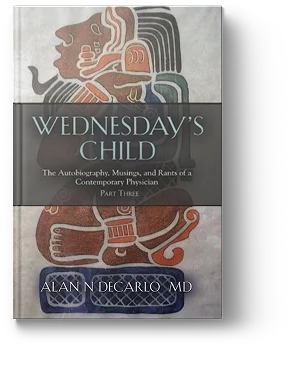

Books
About the Wednesday’s Child Trilogy
A Story of Reflection, Insight, and Personal Journey
Wednesday’s Child is a three-part autobiographical series that follows the arc of a life through Youth, Manhood, and Old Age. More than a memoir, Alan N. DeCarlo describes the work as a kind of para-biography, using his own experiences as an anchor point for larger reflections on learning, ambition, illness, family, relationships, burnout, mortality, and the strange contradictions that shape a human life.
Written from firsthand experience, the trilogy is rooted in DeCarlo’s long medical career, but it reaches far beyond medicine. These books move through personal history, cultural observation, philosophical reflection, and blunt social critique. The result is a work that feels intimate, provocative, and often unexpectedly funny.
The project began with a personal fear: the possibility of losing memory before having the chance to record it. After witnessing his mother’s decline from Alzheimer’s disease and reflecting on the devastating course of ALS in his family, DeCarlo began writing as an act of preservation. These volumes became his effort to remember, before memory itself could disappear.
Each book takes on a different phase of life. Part One: Youth lays the foundation with family history, early identity, and the formation of a worldview. Part Two: Manhood moves into training, work, responsibility, and the hard lessons of adult life. Part Three: Old Age turns toward regret, resilience, life cycles, and what it means to look back without sentimentality.
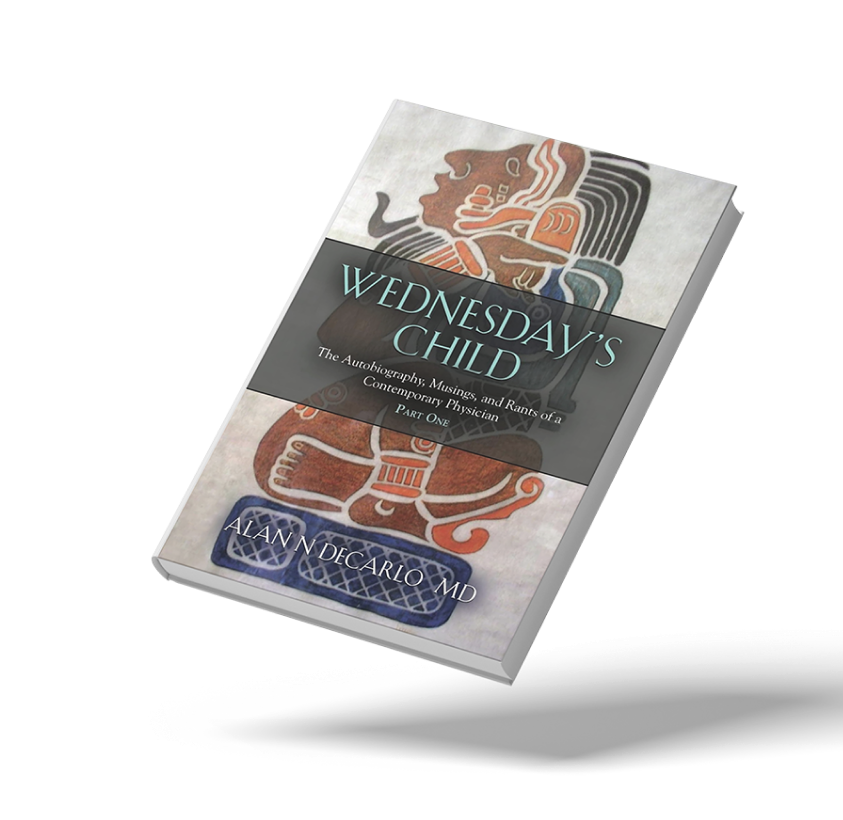
Wednesday’s Child, Part One: Youth
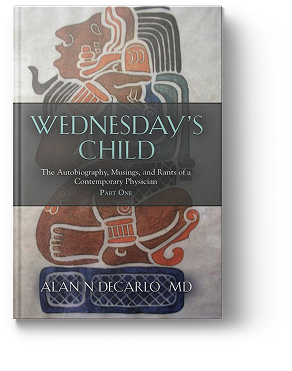
Wednesday’s Child, Part Two: Manhood
The second book shifts focus to the hard lessons of adulthood, career building, and the heavy mantle of responsibility. DeCarlo chronicles five intense years of postgraduate training in Internal Medicine and Cardiology at a New York City hospital bordering Harlem during the violent, crime-ridden 1970s. He provides a blunt social critique of an era marked by the disco craze, rampant drug use, and the tragic onset of the AIDS epidemic. DeCarlo then moves to the affluent Long Island Hamptons to build a cardiology practice, where he navigates the business of medicine, the looming threats of malpractice, and frustrating government regulations. Along the way, his life intersects with a bizarre cast of characters, including a CIA operative, a loan shark, and various celebrities. The book concludes with his transition from clinical practice to bureaucratic oversight as a hospital Medical Director, confronting the dysfunctions of the medical system head-on.
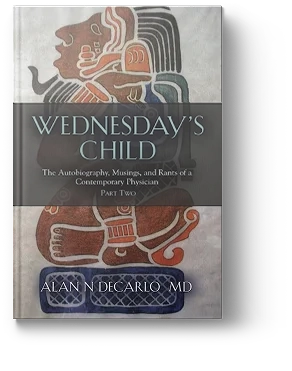
Wednesday’s Child, Part Three: Old Age
The final volume turns its gaze toward resilience, the cycles of life, and the strange contradictions of mortality, examining the past with clear-eyed reflection rather than sentimentality. DeCarlo details a brief clinical tenure in Tennessee, his eventual struggle with burnout, and his transition into retirement and volunteer work. Born out of a deep-seated fear of losing his memory—having watched his mother succumb to Alzheimer’s and witnessing the devastation of ALS in his family—DeCarlo writes as an act of preservation. He details the emotional burden of caring for aging parents while simultaneously zooming out to offer provocative, philosophical musings on the world at large. Weaving together his personal history with broader societal issues, he tackles topics ranging from global warming and political bias to the ultimate future of our planet in the universe.